
laissez un message
Si nos produits vous intéressent et que vous souhaitez en savoir plus, veuillez laisser un message ici, nous vous répondrons dans les plus brefs délais.



RFID vs. Barcode: Key Differences, Advantages, and How to Choose the Right Solution
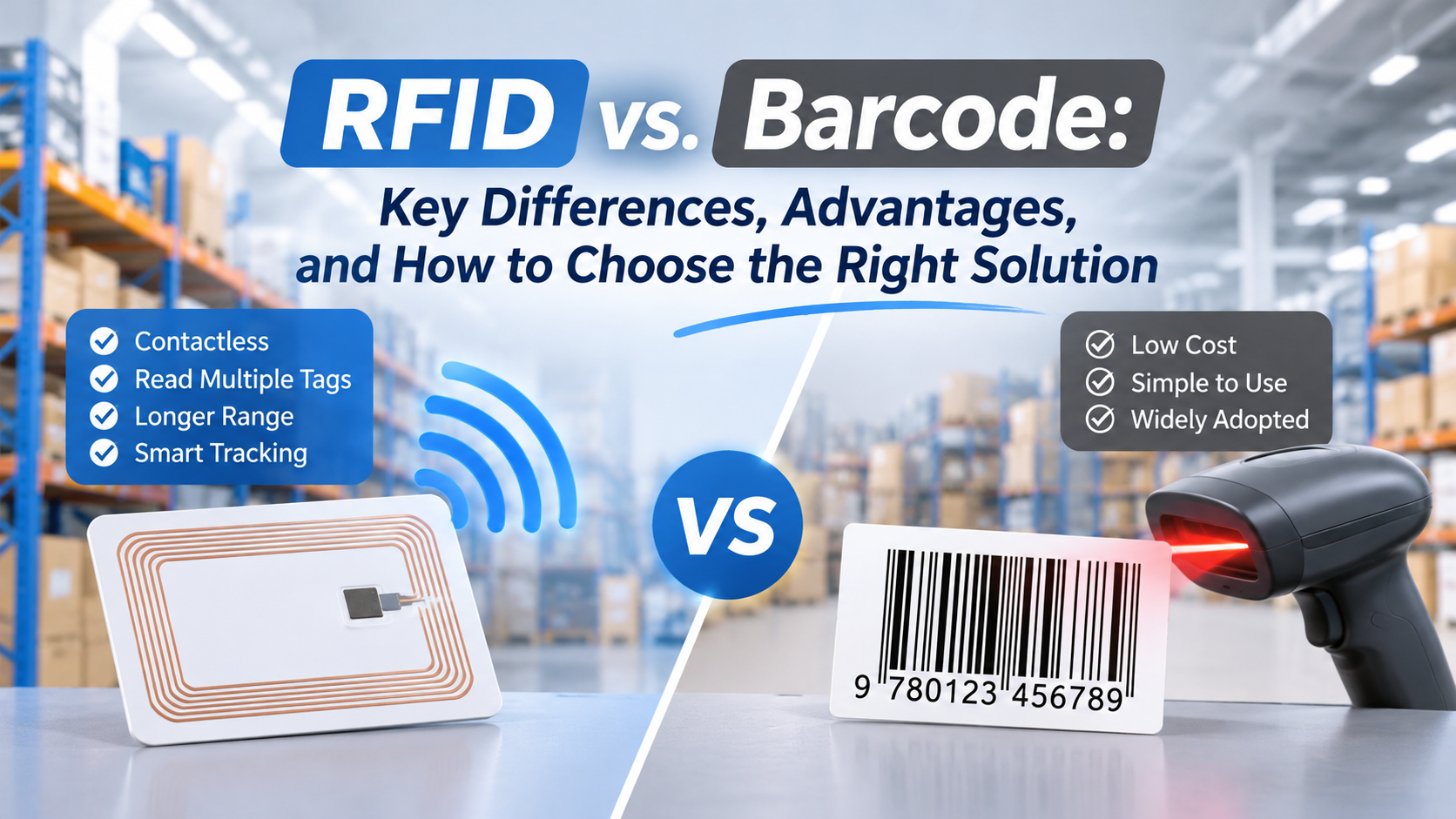
In today's increasingly digital business environment, accurate product identification and efficient inventory management are essential for improving operational efficiency. Whether in manufacturing, warehousing, retail, logistics, or supply chain management, businesses need reliable technologies to identify, track, and manage products throughout their lifecycle.
Two of the most widely used identification technologies are RFID (Radio Frequency Identification) and barcodes. Both help businesses collect product information, improve inventory visibility, and reduce manual data entry. However, they work in very different ways and offer different advantages.
Barcode technology has been widely adopted for decades because of its low cost, simple implementation, and compatibility with existing business systems. RFID, on the other hand, uses radio waves to identify and track tagged objects without requiring direct visual contact. It can also read multiple tags simultaneously, making it particularly useful for applications that require faster data collection and real-time tracking.
So, which technology is better for your business? The answer depends on your operational requirements, budget, working environment, and long-term development goals. Understanding the differences between RFID and barcodes can help you make a more informed decision.
A barcode is a visual identification system that represents information through a series of parallel lines, spaces, or patterns. Each barcode contains a unique identifier that can be scanned by a barcode reader or mobile device.
When a product passes through the scanning process, the reader captures the barcode information and sends it to a connected computer or management system. The system then retrieves the corresponding product information, such as its name, price, quantity, or storage location.
Barcodes are commonly used in supermarkets, retail stores, warehouses, libraries, and logistics centers. They are especially suitable for businesses that need a straightforward and affordable identification solution.
There are two common types of barcodes:
1D Barcodes: Traditional linear barcodes, such as UPC and EAN, which store information in a series of lines and spaces.
2D Barcodes: Two-dimensional codes, such as QR codes and Data Matrix codes, which store more information in a compact area.
One of the biggest advantages of barcode technology is its simplicity. Businesses can print barcode labels at relatively low cost and use standard scanners to collect information. However, barcode scanning generally requires the reader to see the label clearly, which can become inconvenient when handling large quantities of products.
RFID stands for Radio Frequency Identification. It is a wireless identification technology that uses radio waves to identify and collect information from RFID tags attached to objects.
A typical RFID system consists of three main components: RFID tags, RFID readers, and a data processing system.
An RFID tag contains a microchip and an antenna. The chip stores identification information, while the antenna communicates with an RFID reader. When a tag enters the reader's effective radio frequency field, the reader can obtain the information stored on the tag.
Unlike traditional barcode systems, RFID does not generally require direct line-of-sight scanning. Depending on the frequency, tag design, reader power, antenna configuration, and surrounding environment, RFID systems can identify tags from different distances.
RFID technology includes several frequency categories:
LF RFID: Typically operates at 125–134.2 kHz and is commonly used for animal identification and access control.
HF RFID: Operates at 13.56 MHz and is widely used in smart cards, library management, and NFC applications.
UHF RFID: Commonly operates in regional frequency bands such as 860–960 MHz and is widely used for warehouse management, logistics, industrial asset tracking, and retail inventory management.
UHF RFID is particularly valuable in applications where businesses need to identify multiple items quickly. With an appropriate reader and antenna configuration, hundreds of RFID tags can be detected within a short period, significantly reducing manual scanning operations.
Although RFID and barcode technologies serve similar identification purposes, their working principles create several important differences.
The most obvious difference is how the two technologies collect information.
Barcode systems require a scanner to capture the printed code visually. The barcode must generally be visible, properly positioned, and free from excessive dirt or damage.
RFID systems use radio waves to communicate with tags. The reader does not need to visually identify each individual tag, allowing objects to be scanned even when labels are hidden inside boxes or attached to different sides of products.
This makes RFID particularly useful in warehouse operations, where employees often handle large quantities of goods.
Barcode scanning is usually a one-by-one process. Employees must position the scanner correctly and scan each item individually.
RFID can read multiple tags within the same interrogation area simultaneously. For example, when a group of tagged products passes through an RFID gate, the system can identify several items automatically without requiring employees to scan each product separately.
For businesses managing thousands of items every day, this difference can significantly improve inventory efficiency.
Barcode readers typically need to be relatively close to the barcode, depending on the scanner type and code size.
RFID reading distance varies according to the frequency, tag sensitivity, reader output power, antenna gain, and environmental conditions. UHF RFID systems can achieve reading distances of several meters or more under suitable conditions.
This allows businesses to build automatic identification systems at warehouse entrances, production lines, loading areas, and vehicle access points.
Traditional barcodes mainly provide an identifier that links to information stored in a database. Some 2D barcodes can store more information directly, but their data capacity remains limited compared with many RFID solutions.
RFID tags can store identification data and, depending on the tag type, additional information that can be read or updated by compatible readers.
Some RFID tags also support data protection features, access control, and password-based operations, making them suitable for applications with more complex information management requirements.
Barcode labels can become difficult to scan when they are scratched, dirty, wet, or exposed to harsh environmental conditions.
RFID tags are available in different materials and structures, including waterproof tags, industrial tags, high-temperature tags, and on-metal tags.
For applications involving metal equipment, outdoor assets, industrial containers, or reusable transport packaging, specialized RFID tags can provide more reliable identification.
However, RFID is not completely immune to environmental interference. Metal surfaces, liquids, electromagnetic interference, and improper antenna placement may affect reading performance. Proper system design and testing are therefore important.
|
Comparison |
RFID |
Barcode |
|---|---|---|
|
Identification method |
Radio frequency |
Optical scanning |
|
Line of sight |
Not generally required |
Required |
|
Reading process |
Multiple tags simultaneously |
Usually one at a time |
|
Reading distance |
From centimeters to several meters or more, depending on the system |
Generally short-range |
|
Data storage |
Available on compatible tags |
Primarily an identifier |
|
Data modification |
Supported by some RFID tags |
Printed data is generally fixed |
|
Scanning speed |
High |
Depends on manual scanning |
|
Initial investment |
Generally higher |
Generally lower |
|
Label cost |
Generally higher |
Very low |
|
Environmental adaptability |
Specialized tags are available |
Labels may be affected by physical damage |
|
Best applications |
Automated tracking and inventory management |
Basic identification and checkout |
The comparison shows that RFID offers stronger automation capabilities, while barcodes remain an economical and practical option for basic identification tasks.
Different industries have different identification requirements. Understanding how these technologies perform in real business environments can help companies select the right solution.
Warehouses need to manage large volumes of products, incoming shipments, outgoing orders, and inventory movements.
Barcode systems allow employees to scan products during receiving, picking, packing, and shipping. However, when inventory volumes increase, scanning every individual item can consume considerable time.
RFID provides a more automated approach. By installing UHF RFID readers and antennas at warehouse entrances or storage areas, businesses can identify tagged products as they move through designated reading zones.
This helps improve inventory accuracy, reduce manual operations, and provide better visibility into stock movements.
Barcodes are widely used in retail checkout systems because they are inexpensive and easy to implement.
RFID offers additional advantages in inventory counting, product tracking, and loss prevention. Retailers can use RFID handheld readers to conduct inventory checks without locating and scanning every product label individually.
For clothing retailers, RFID tags can help monitor product availability, identify misplaced items, and improve replenishment efficiency.
Manufacturing companies need to track raw materials, work-in-progress products, tools, and finished goods throughout production.
Barcode systems can record production stages through manual scanning. RFID can automate identification at different production stations, helping manufacturers monitor material movement and improve production visibility.
For industrial asset management, specialized RFID tags can be attached to equipment, containers, and tools to support automatic identification and periodic inventory checks.
In logistics operations, products frequently move between warehouses, distribution centers, and transportation vehicles.
Barcode scanning is useful for package identification and delivery verification. However, RFID can provide faster batch identification at loading docks and distribution checkpoints.
By combining RFID readers, antennas, and management software, logistics companies can improve shipment visibility and reduce the time required for cargo identification.
There is no universal answer when choosing between RFID and barcode technology. Businesses should evaluate their actual operational needs rather than simply selecting the newest technology.
Consider your inventory volume.
If your business manages a relatively small number of products and does not require frequent inventory checks, barcode technology may be sufficient. If you handle thousands of items daily, RFID may provide greater efficiency.
Evaluate your automation requirements.
Businesses looking to reduce manual scanning and automate product identification should consider RFID. Its ability to read multiple tags simultaneously makes it suitable for automated warehouses, production lines, and logistics systems.
Calculate the total cost of ownership.
Barcode systems generally have lower initial costs. RFID requires investment in readers, antennas, tags, software, and system integration. However, businesses should also consider labor savings, inventory accuracy, operational efficiency, and long-term maintenance costs.
Consider the working environment.
For environments involving metal equipment, liquids, outdoor storage, or high temperatures, businesses should evaluate whether suitable RFID tags are available. Barcode labels may be more appropriate for simpler environments where visual scanning is convenient.
Think about future scalability.
If your business plans to expand warehouse capacity, increase production volume, or introduce automated inventory management, RFID may provide greater flexibility for future development.
RFID and barcode technologies do not necessarily need to replace one another. In many business environments, combining both technologies can provide a more practical solution.
For example, a warehouse may use barcode labels for product identification during manual operations while using UHF RFID tags for automatic inventory tracking and goods movement monitoring.
A product can carry both a barcode and an RFID tag. Employees can use barcode scanners for basic operations, while RFID readers automatically collect information at important checkpoints.
This hybrid approach allows businesses to maintain compatibility with existing systems while gradually introducing automation.
For companies that are not ready to replace their entire identification infrastructure, combining RFID and barcode technology can be a cost-effective transition strategy.
RFID and barcode technologies both play important roles in modern business operations, but they are designed to address different identification needs.
Barcodes remain an excellent choice for businesses that prioritize low costs, simple implementation, and straightforward product identification. RFID offers greater automation potential, faster batch reading, and improved visibility for businesses managing complex inventory and asset tracking operations.
For companies looking to improve warehouse efficiency, automate inventory management, and build smarter supply chain systems, UHF RFID technology is worth considering.
Ultimately, the best choice depends on your business size, operational requirements, investment budget, and future development plans. By evaluating these factors carefully, businesses can select an identification solution that improves efficiency while supporting long-term growth.

Informations détaillées et PDF

Contact par e-mail pour l'assistance.

Assistance technique professionnelle.

Contact par e-mail pour l'assistance.



LIEN

YouTube

laissez un message
Scannez vers WeChat/WhatsApp :



 IPv6 RÉSEAU PRIS EN CHARGE