
laissez un message
Si nos produits vous intéressent et que vous souhaitez en savoir plus, veuillez laisser un message ici, nous vous répondrons dans les plus brefs délais.




Mon meilleur achat de cet hiver ! La couleur et le tricot sont magnifiques et il est tellement confortable ! Je l'ai porté de New York à Miami sans jamais l'enlever. Trop mignon !
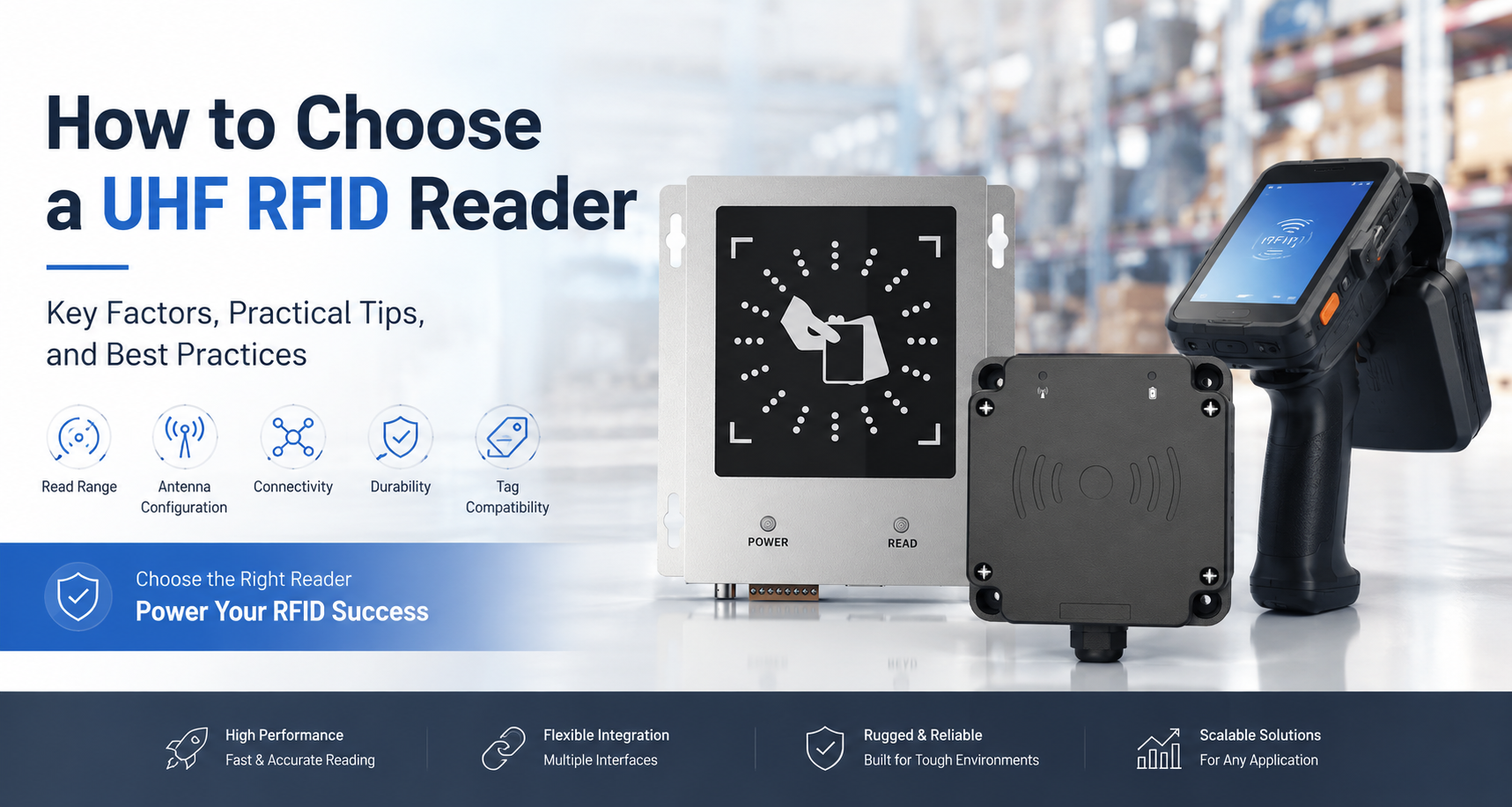
La technologie RFID UHF est devenue un outil essentiel pour l'identification automatique et le suivi en temps réel des actifs dans tous les secteurs d'activité. De la gestion des stocks en entrepôt et du commerce de détail à la production industrielle, la logistique, la gestion de véhicules et le suivi du personnel, les lecteurs RFID UHF jouent un rôle central dans la collecte rapide et précise des données issues des étiquettes RFID.
Cependant, choisir le lecteur RFID UHF adapté ne se résume pas à sélectionner l'appareil offrant la plus grande portée de lecture ou la puissance de sortie la plus élevée. Les exigences en matière de portée de lecture, de configuration d'antenne, de connectivité, d'environnement d'installation, de densité d'étiquettes et d'intégration système varient selon les applications.
Comment les entreprises peuvent-elles choisir un lecteur RFID UHF adapté ? Ce guide explique les principaux facteurs à prendre en compte avant de faire votre choix.
La première étape dans le choix d'un lecteur RFID UHF consiste à définir clairement comment et où le lecteur sera utilisé.
Différentes applications requièrent différentes configurations de lecteurs. Par exemple, un entrepôt peut nécessiter un lecteur RFID UHF fixe installé à une entrée pour identifier les marchandises étiquetées lors de leur passage. Un magasin peut avoir besoin d'un lecteur compact pour le comptage des stocks et la lutte contre le vol. Une chaîne de production industrielle peut nécessiter un lecteur RFID robuste capable de fonctionner en continu dans un environnement exigeant.
Les applications courantes de la RFID UHF comprennent :
Gestion des stocks d'entrepôt
Suivi logistique et de la chaîne d'approvisionnement
Systèmes d'inventaire et antivol pour le commerce de détail
suivi des actifs industriels
Gestion de la chaîne de production
Identification des véhicules et contrôle d'accès
Gestion de bibliothèques et de documents
Identification du personnel
Suivi du bétail et des animaux
Avant de choisir un lecteur, tenez compte des objets à suivre, de la distance de lecture, de la vitesse de déplacement, du nombre d'étiquettes, du lieu d'installation et des conditions environnementales.
Une bonne compréhension de l'application vous permettra d'éviter de payer pour des fonctionnalités inutiles tout en garantissant des performances suffisantes pour le lecteur.
La distance de lecture est l'une des spécifications les plus importantes d'un lecteur RFID UHF.
La portée de lecture effective peut varier considérablement en fonction du lecteur, de l'antenne, de l'étiquette RFID, de l'environnement d'installation et de la puissance de sortie. Certaines applications ne nécessitent qu'une distance de lecture inférieure à un mètre, tandis que d'autres peuvent en exiger plusieurs mètres, voire plus.
Par exemple, un lecteur RFID de bureau utilisé pour la gestion de documents ou l'identification de petits objets ne nécessite généralement pas une très grande portée de lecture. En revanche, un système de contrôle d'accès d'entrepôt ou de gestion de véhicules peut exiger un lecteur RFID longue portée capable d'identifier les étiquettes à une distance plus importante.
Il est important de noter que la portée maximale annoncée du lecteur ne correspond pas nécessairement à la portée réelle que vous obtiendrez lors de votre utilisation. Les objets métalliques, les liquides, l'orientation de l'étiquette, le positionnement de l'antenne, les interférences et les matériaux environnants peuvent tous affecter les performances RFID.
Par conséquent, au lieu de choisir un lecteur uniquement en fonction de sa distance de lecture maximale, évaluez ses performances dans des conditions réelles d'utilisation.
Les lecteurs RFID UHF fonctionnent dans des bandes de fréquences réglementées, et ces bandes varient selon les régions.
Pour les applications internationales, les entreprises doivent vérifier que le lecteur prend en charge la gamme de fréquences appropriée au marché cible. Un lecteur conçu pour une région peut ne pas être conforme à la réglementation en vigueur dans une autre.
Outre la compatibilité de fréquence, vérifiez le protocole RFID pris en charge par le lecteur. La plupart des systèmes RFID UHF modernes utilisent la norme EPCglobal Class 1 Gen 2, communément appelée ISO/IEC 18000-63.
Choisir un lecteur compatible avec les normes largement adoptées offre une meilleure compatibilité avec les différentes étiquettes RFID et les composants du système.
Pour les entreprises qui envisagent d'étendre leur déploiement RFID à l'avenir, les équipements conformes aux normes peuvent également faciliter les mises à niveau du système et les changements de fournisseurs.
L'antenne est tout aussi importante que le lecteur RFID lui-même.
Un lecteur RFID UHF peut prendre en charge un ou plusieurs ports d'antenne. Le nombre de ports d'antenne détermine le nombre d'antennes pouvant être connectées au lecteur et influe donc sur la zone de couverture et la conception de l'application.
Par exemple:
1 à 2 ports d'antenne peuvent convenir aux applications d'identification simples.
Quatre ports d'antenne permettent une couverture plus étendue pour les entrées d'entrepôt ou les lignes de production.
Huit ports ou plus peuvent être utiles pour les portails de grande taille et les systèmes de suivi complexes.
Le type d'antenne a également son importance. Les antennes directionnelles sont souvent adaptées aux zones de lecture contrôlées, tandis que différentes options de polarisation peuvent améliorer la lisibilité des étiquettes lorsque leur orientation varie.
Lors du choix d'un lecteur RFID UHF, tenez compte à la fois du nombre de ports d'antenne et du gain, de la polarisation, de l'angle de couverture et de la position d'installation de l'antenne.
Dans de nombreuses applications concrètes, les lecteurs RFID doivent identifier simultanément plusieurs étiquettes.
Par exemple, des centaines de produits peuvent être placés sur une palette, ou des dizaines d'articles étiquetés peuvent franchir simultanément un portique RFID. Dans ces situations, la résistance aux collisions devient primordiale.
Un lecteur RFID UHF de haute qualité doit être capable d'identifier efficacement plusieurs étiquettes tout en minimisant les lectures manquées et les lectures en double.
Les entreprises devraient donc aller au-delà de la simple spécification de « plage de lecture » et évaluer :
vitesse de lecture
Capacité d'identification multi-étiquettes
Performances anti-collision
capacité de traitement des étiquettes
Précision de la lecture
Capacité de filtrage des données
Pour les applications à grand volume, il est fortement recommandé de tester le lecteur avec les étiquettes RFID et les objets réellement utilisés dans le projet.
Un lecteur RFID UHF doit communiquer avec le système hôte ; la connectivité est donc un autre élément important à prendre en compte.
Les interfaces courantes comprennent :
Ethernet
USB
RS232
RS485
Wi-Fi
Bluetooth
TCP/IP
Pour les lecteurs RFID fixes installés dans les entrepôts ou les usines, l'Ethernet est souvent un choix pratique car il prend en charge une communication réseau fiable et une gestion à distance.
Pour les applications de bureau, l'USB est pratique car le lecteur peut être connecté directement à un ordinateur.
Pour les environnements industriels, les interfaces RS232 ou RS485 peuvent être préférées lors de l'intégration avec des automates programmables, des contrôleurs industriels ou des systèmes d'automatisation existants.
La meilleure interface dépend de votre infrastructure et de votre architecture système existantes.
Les performances matérielles ne représentent qu'une partie d'un système RFID. L'intégration logicielle est tout aussi importante.
Avant d'acheter un lecteur RFID UHF, vérifiez si le fabricant fournit un SDK, une API, une documentation sur le protocole de communication, des exemples de code et une assistance technique.
Un SDK bien conçu peut réduire considérablement le temps de développement lors de l'intégration du lecteur avec des systèmes de gestion d'entrepôt, des logiciels ERP, des plateformes MES, des systèmes de contrôle d'accès ou des applications personnalisées.
Vous devez également vérifier si le lecteur prend en charge les systèmes d'exploitation et les environnements de programmation courants utilisés par votre équipe de développement.
Pour les entreprises qui développent des solutions RFID personnalisées, un support logiciel performant peut être tout aussi précieux que le matériel lui-même.
L'environnement d'exploitation doit toujours être pris en compte avant de choisir un lecteur RFID.
Les exigences d'un lecteur installé à l'intérieur d'un bureau sont très différentes de celles d'un lecteur installé à l'extérieur, dans un entrepôt ou sur une chaîne de production.
Pour les environnements difficiles, consultez :
Température de fonctionnement
Résistance à l'humidité
Protection contre la poussière
Résistance à l'eau
résistance aux vibrations
résistance aux chocs
Matériau du boîtier
Indice de protection IP
Si le lecteur est installé à l'extérieur, par exemple pour la gestion des véhicules, il doit pouvoir résister aux variations de température, à l'humidité, à la poussière et aux autres conditions environnementales.
Pour les applications industrielles, un lecteur RFID robuste peut offrir une meilleure fiabilité et réduire les coûts de maintenance à long terme.
La consommation d'énergie et les options d'alimentation peuvent également influencer le choix du lecteur RFID.
Certains lecteurs fixes utilisent une alimentation CC standard, tandis que d'autres peuvent prendre en charge l'alimentation par Ethernet (PoE), permettant à la fois l'alimentation et la communication réseau via un seul câble Ethernet.
Pour les installations où le déploiement des câbles d'alimentation est difficile, la technologie PoE peut simplifier l'installation.
Pour les équipements RFID portables ou mobiles, l'autonomie de la batterie devient un facteur plus important.
Choisir la solution d'alimentation électrique appropriée peut contribuer à réduire la complexité de l'installation et les coûts d'exploitation.
Un système RFID ne doit pas seulement répondre aux exigences actuelles, il doit aussi permettre une évolution future.
Par exemple, une entreprise peut initialement déployer la technologie RFID dans un seul entrepôt, puis étendre le système à plusieurs entrepôts, lignes de production ou centres de distribution.
Lors du choix d'un lecteur, tenez compte de sa compatibilité avec :
Antennes supplémentaires
Plus d'étiquettes RFID
Déploiements de réseaux à plus grande échelle
configuration à distance
Mises à jour du firmware
Intégration cloud ou serveur
Plusieurs protocoles de communication
Choisir dès le départ un matériel évolutif peut réduire le coût et la complexité des extensions futures.
Le prix est important, mais le lecteur RFID le moins cher n'est pas toujours l'option la plus rentable.
Le coût total d'un système RFID peut comprendre :
lecteurs RFID
antennes RFID
Étiquettes RFID
Alimentations électriques
Équipement réseau
Logiciel
Installation
Intégration
Entretien
assistance technique
Un lecteur bon marché dont les performances de lecture sont médiocres ou dont le support logiciel est limité peut entraîner des coûts d'intégration et de maintenance plus élevés au fil du temps.
Évaluez plutôt le coût total de possession et le retour sur investissement attendu.
Un lecteur RFID UHF fiable, qui améliore la précision des inventaires, réduit les numérisations manuelles et augmente l'efficacité opérationnelle, peut apporter une valeur ajoutée considérablement supérieure tout au long de sa durée de vie.
La recommandation la plus importante est peut-être de réaliser un test en conditions réelles avant d'acheter une grande quantité de lecteurs RFID.
Les performances RFID dépendent fortement de l'interaction entre le lecteur, l'antenne, l'étiquette, l'objet et l'environnement.
Par exemple, les étiquettes RFID fixées sur des surfaces métalliques peuvent nécessiter des étiquettes spécifiques. Les liquides peuvent également affecter les performances des étiquettes RFID UHF. Différentes orientations d'étiquette peuvent produire des résultats de lecture différents.
Par conséquent, un lecteur performant en laboratoire ne donnera pas forcément les mêmes résultats dans votre entrepôt ou votre usine.
Un projet pilote peut vous aider à évaluer :
Distance de lecture réelle
précision de lecture
Performance multi-étiquettes
Couverture d'antenne
Ingérence
Stabilité du réseau
Performances d'intégration
fiabilité à long terme
Tester les produits réels dans leur environnement d'utilisation réel est l'un des meilleurs moyens de sélectionner le lecteur RFID UHF adapté.
Choisir un lecteur RFID UHF ne se résume pas à comparer les spécifications et les prix. Le lecteur idéal doit correspondre à votre application, à votre portée de lecture, aux exigences de votre antenne, à la densité d'étiquettes souhaitée, à votre interface de communication, à votre environnement logiciel et à vos conditions d'utilisation.
Avant de prendre une décision, définissez clairement les exigences de votre application, évaluez les spécifications techniques du lecteur, testez-le avec vos étiquettes RFID réelles et tenez compte de l'extension future du système.
Pour les entreprises souhaitant mettre en place des solutions RFID fiables, collaborer avec un fabricant et fournisseur de solutions RFID expérimenté peut simplifier le processus de sélection et d'intégration. Un fournisseur professionnel peut les aider à choisir le lecteur RFID UHF, l'antenne, l'étiquette et l'architecture logicielle les mieux adaptés à leur application.
En définitive, le meilleur lecteur RFID UHF n'est pas forcément celui qui possède les spécifications les plus élevées. C'est celui qui offre Identification stable, collecte de données fiable, intégration facile et valeur ajoutée à long terme pour votre application spécifique.

Informations détaillées et PDF

Contact par e-mail pour l'assistance.

Assistance technique professionnelle.

Contact par e-mail pour l'assistance.



LIEN

YouTube

laissez un message
Scannez vers WeChat/WhatsApp :



 IPv6 RÉSEAU PRIS EN CHARGE